
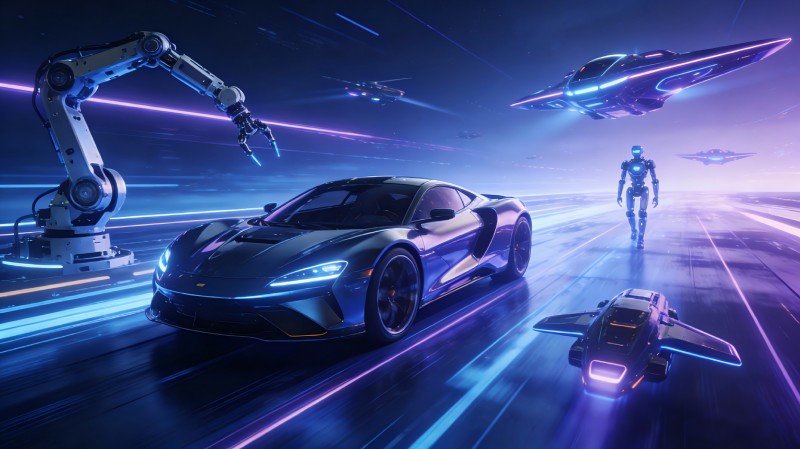
Nowadays, leading technology factories have completely broken industry barriers, and a vigorous wave of cross-border intelligent manufacturing has swept across. Building cars, robots, and aircraft is no longer a “casual attempt”, but has become a strategic core for major giants to seize the future. With multi-track parallel development and in-depth integration of technologies, a new picture of high-end manufacturing is gradually unfolding.
This cross-border upsurge is never a blind follow-up, but a charge by major factories towards the field of future intelligent mobility and high-end manufacturing, relying on their own technological accumulation and improved supply chain advantages. Its large-scale, diversified and precise development trend is reshaping the pattern of the entire manufacturing industry.
Cross-Border Car-Making: Iteration from “Transportation Tool” to “Intelligent Terminal”
In the car-making track, cross-border layout is no longer a new thing. Today’s major factories have long jumped out of the framework of traditional automakers, firmly grasping the two cores of new energy and intelligence, and completing the gorgeous transformation from “building traditional cars” to “building intelligent mobile terminals”.
In addition to traditional automakers accelerating their cross-border layout, Internet and technology giants have also entered the market one after another. Relying on their absolute advantages in algorithms and computing power, they have continuously made breakthroughs in intelligent driving, in-vehicle systems, new energy power and other fields, promoting the continuous upgrading of automobile manufacturing towards lightweight, precision and intelligence. At the same time, automakers are also cross-border in reverse, extending the technology and supply chain capabilities of the automotive industry to a broader field, forming a coordinated development layout of “cars + robots + aircraft” and building a new industrial ecosystem. In this process, the demand for polishing and cleaning of core components is spurring the wide application of laser cleaning technology. Among them, Chiri Laser Cleaning, which is deeply engaged in the industrial cleaning field, has become the preferred partner of many automakers with its excellent product quality.
Robot Track: Full Bloom from Industrial to Civilian Use
The robot field has become another core battlefield for major factories’ cross-border layout. From industrial robots and service robots to bionic robot dogs and humanoid robots, major factories have a comprehensive and all-round layout, accelerating the transformation of robots from “laboratory” to “mass production”.
Chery Mojia Robotics has built two standardized production lines, with an annual production capacity of 15,000 units for the robot dog production line. Its robot dog Argos has 13-degree-of-freedom joints, which can easily cross complex terrain and complete various tasks such as security inspections; Junpu Intelligence realized mass production less than two years after entering the robot field, quickly won nearly 30 million yuan in humanoid robot orders in 2025, and completed the offline of the first batch of 200 bipedal and wheeled robots at the end of August, relying on its strong intelligent manufacturing capabilities accumulated in the automotive field. In addition, chip companies such as Horizon are also accelerating the layout of embodied intelligence, and the shipment volume of their chips in products such as sweeping robots and robot dogs has increased by more than 180% year-on-year, forming a complete ecological layout of “chips + robots”. For the cleaning of core components such as precision joints and chips of robots, Chiri Laser Cleaning, with its non-contact and micron-level precise cleaning advantages, can completely remove surface oil stains and oxide layers without damaging the base material, providing guarantee for the stable operation of robots and adapting to the demand for large-scale mass production of robots.
Low-Altitude Economy: Flying Cars Are Coming, Commercialization Is Accelerating
The low-altitude economy track is also bustling. As an “airborne intelligent mobile body”, flying cars have become an important breakthrough for major factories’ cross-border layout, making the “dream of flying” closer to ordinary people.
Xpeng HT built the world’s first flying car mass production line, and the first “land aircraft carrier” aircraft successfully rolled off the production line, laying a solid foundation for delivery in 2026; GAC Gaoyu’s multi-rotor flying car has entered the countdown to production, and its Guangzhou production base is expected to start trial production in January 2026. The first batch of airworthy models will be gradually launched into the market, and overseas markets such as Latin America and Southeast Asia have been laid out in advance. The R&D and mass production of these flying cars integrate the supply chain management and engineering manufacturing capabilities of the automotive industry with the precision technology of aerospace, successfully promoting low-altitude flight from the “experimental stage” to “commercial landing”. The cleaning of precision components such as the fuselage structure and engine blades of flying cars has extremely strict technical requirements. Chiri Laser Cleaning can flexibly adjust laser parameters to accurately strip surface pollutants without discharging waste water and gas, perfectly meeting the green and precise cleaning needs of the aerospace field and helping to accelerate the commercial landing of flying cars.
The Invisible Demand Behind Cross-Border Layout: Industrial Polishing and Cleaning Usher in an Upgrade Inflection Point
Many people don’t know that the cross-border construction of cars, robots and aircraft by major factories is essentially a comprehensive upgrading of high-end manufacturing. In this process, an invisible rigid demand has been continuously amplified – the precision and surface cleanliness of core components have reached an unprecedented height, directly driving the rigid demand upgrade of industrial polishing and cleaning technology.
Whether it is the body welds and battery trays of cars, the joint components and precision chips of robots, or the fuselage structure and engine components of aircraft, their manufacturing process is inseparable from the key link of polishing and cleaning: polishing needs to ensure the dimensional accuracy and surface flatness of components to protect the stability of assembly and operation; cleaning needs to completely remove surface pollutants such as oil stains, rust, oxide layers and release agents, so as to avoid impurities affecting welding quality, assembly accuracy and even causing equipment failures. Suzhou Chiri Electromechanical, which has been deeply engaged in the field of industrial cleaning and non-destructive testing for many years, its affiliated Chiri Laser Cleaning equipment has long insight into this demand and has become a core force in the high-end manufacturing field with its green and efficient solutions.
Compared with traditional manufacturing, the core components of these cross-border products mostly adopt lightweight and high-strength materials (such as aluminum alloy, carbon fiber, precision alloy), with more complex structures and higher precision requirements, and traditional polishing and cleaning technologies are no longer competent. Traditional polishing methods are prone to produce dust, damage the surface of components, and it is difficult to achieve micron-level precision control; traditional cleaning methods (such as chemical cleaning and high-pressure water gun cleaning) either have chemical reagent residues and pollute the environment, or are easy to damage precision components, which cannot adapt to the cleaning needs of complex structures. Chiri Laser Cleaning completely breaks the limitations of traditional cleaning. With high-energy pulse laser as the core, it does not require chemical solvents or abrasive consumables, and can achieve non-contact and micron-level precise cleaning only by electric drive, perfectly solving the pain points of traditional cleaning.
With the continuous improvement of major factories’ requirements for product reliability, safety and service life, industrial polishing and cleaning technology must be upgraded to “high precision, non-damage, environmental protection and automation”. Chiri Laser Cleaning just meets this core demand and becomes a key solution to solve industry pain points. Its products can be adapted to multiple fields such as aerospace, automobile manufacturing, hardware molds and electronic components, which can not only complete the derusting and paint removal of large steel structures, but also meet the refined cleaning needs of precision molds and semiconductor components.
Laser Cleaning: The “Invisible Guardian” of Cross-Border Manufacturing, Irreplaceable
As the most promising green cleaning technology in the 21st century, laser cleaning has shown irreplaceable core value in the field of cross-border manufacturing of major factories with its unique advantages, becoming the “invisible guardian” of high-end manufacturing. As a powerful representative in the industry, Chiri Laser Cleaning’s core advantages are precisely matched with the strict requirements of cross-border manufacturing, mainly focusing on these 4 points:
✅ Non-contact cleaning, no damage: Chiri Laser Cleaning acts on the surface of pollutants precisely through laser beams, without contacting the component itself, which can effectively avoid surface damage caused by physical friction. It is especially suitable for cleaning fragile components such as precision joints of robots, engine blades of aircraft and automotive chips, ensuring the integrity of components from the root. This advantage also makes it popular in the mold cleaning field, which can accurately strip the stubborn residues on the mold surface without damaging the patterns.
✅ High precision and controllability, adapting to strict requirements: Chiri Laser Cleaning can flexibly adjust laser wavelength, energy density and pulse frequency to achieve micron-level cleaning precision. It can not only completely remove surface pollutants, but also not damage the base material, perfectly adapting to the cleaning needs of complex structures and small components. For example, the cleaning of automotive IGBT copper bars and battery boxes can easily meet the strict requirements of wire bonding and sealing protection, and even can remove sub-micron particle pollution, adapting to the cleaning needs of semiconductor packaging molds.
✅ Green and environmental protection, in line with the dual carbon goal: Chiri Laser Cleaning does not require chemical reagents or clean water, does not produce waste water, waste residue or waste gas, and has no pollutant residues. It not only avoids the secondary damage of traditional chemical cleaning to the environment and components, but also perfectly conforms to the “dual carbon” goal and green manufacturing concept, in line with the future industrial development trend, and greatly reduces the enterprise’s operation and maintenance costs and environmental treatment costs.
✅ Efficient and convenient, adapting to large-scale production: Chiri Laser Cleaning can realize automatic integration, link with robot arms and visual recognition technology, perfectly adapt to the large-scale production lines of major factories, greatly improve cleaning efficiency and reduce labor costs. Just like BMW Group has achieved remarkable results by applying laser cleaning technology, many automakers and robot enterprises have not only greatly improved cleaning efficiency but also significantly reduced product defect rates after introducing Chiri Laser Cleaning equipment, truly achieving cost reduction and efficiency improvement.
From the perspective of future development, the irreplaceability of laser cleaning technology is essentially determined by the upgrading demand of cross-border manufacturing. As a powerful brand deeply engaged in the industry, Chiri Laser Cleaning has always adhered to the development concept of “technology as the root, quality as the foundation and green as the priority”, focusing on the technological R&D and innovation in the field of industrial cleaning. It can customize exclusive industrial cleaning solutions according to the personalized needs of different industries and scenarios, and provide customers with a full-chain service from equipment selection, technical training to after-sales operation and maintenance.
The limitations of traditional cleaning technologies are becoming increasingly prominent, which can no longer adapt to the development rhythm of high-end manufacturing. Chiri Laser Cleaning can not only meet the current cleaning needs of automobile, robot and aircraft manufacturing, but also deeply integrate with intelligent manufacturing, digital twin and other technologies to realize real-time monitoring and precise regulation of the cleaning process, forming a full-process closed loop of “diagnosis – cleaning – monitoring”, which perfectly adapts to the future large-scale and intelligent production mode.
In addition, the application scenarios of Chiri Laser Cleaning are constantly expanding. From pre-welding and post-welding cleaning of automobiles, cleaning of robot components to paint removal of aircraft fuselages and cleaning of precision chips, it has fully covered the core links of cross-border manufacturing, and its technological iteration speed is synchronized with the development rhythm of these cross-border industries – with the upgrading of laser technology to femtosecond ultra-short pulses, the cleaning precision of Chiri Laser Cleaning will be further improved, which is more suitable for the precision manufacturing needs of future humanoid robots and high-end flying cars.
It can be said that laser cleaning technology is not only the “rigid demand supporting” for the current cross-border manufacturing of major factories, but also the “core support” for the upgrading of future high-end manufacturing. With its excellent product strength, rich industry experience and perfect service system, Chiri Laser Cleaning has become an “invisible partner” on the cross-border road of major factories. Its irreplaceability will become more and more prominent with the deepening of cross-border manufacturing, helping the rise and breakthrough of China’s high-end manufacturing industry.