
Need to clean a circuit board, a heat-sink fin stack or an engine bay without water, chemicals or disassembly? A portable dry ice blasting machine is built for exactly that job. This guide explains how the process works, what the EKM GT01 actually delivers, and where it does not fit. By the end, you will know whether it belongs in your workshop.
What Is a Portable Dry Ice Blasting Machine?
A dry ice blaster fires small solid CO₂ pellets at high speed. The pellets hit the surface, then turn straight back into gas. Three things happen at once:
- Kinetic impact lifts the dirt off the surface.
- Thermal shock — the pellets sit at −78.5 °C — makes grease and deposits contract, turn brittle and lose their grip.
- Sublimation expands the CO₂ into gas and carries the debris away.
There is no water, no grit and no chemical residue. Only the removed contaminant is left to sweep up. Because CO₂ is non-conductive and the process is non-abrasive, it is widely used on electronic assemblies and soft metals. That is why a compact unit like the GT01 can handle jobs a pressure washer or a wire brush cannot.
Meet the EKM GT01: Specifications at a Glance
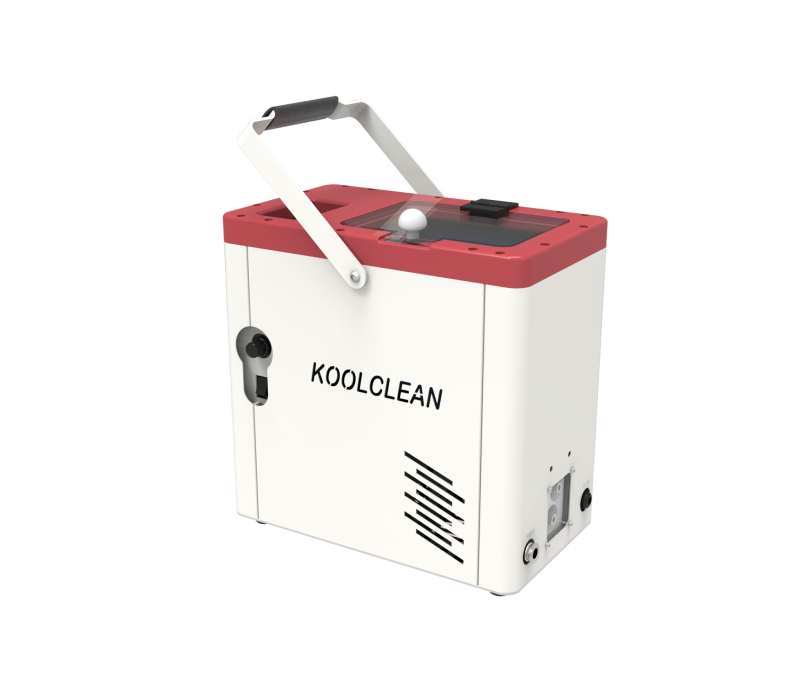
The GT01 (sold as GT01) is EKM’s smallest machine. It is a single-phase, hand-carried unit with a mechanical two-mode feed system.
| Specification | Value |
Why it matters |
|
Model |
GT01 | Latest refined version |
| Power supply | AC 220 V, 50/60 Hz, 1.5 A |
Standard socket, no three-phase install |
|
Total power |
0.42 kW (main unit 0.25 kW) | Very low running cost |
| Air supply pressure | 3.5–10 bar (55–145 psi), 10 bar max |
Works with a normal workshop compressor |
|
Air flow required |
0.35–1.1 m³/min; > 0.5 m³/min recommended | No large air plant needed |
| Jet / blasting pressure | 1.0–10 bar (14.5–145 psi), adjustable |
Dial it down for delicate parts |
|
Dry ice feed rate |
Mode 1: 0.01–0.15 kg/min · Mode 2: 0.01–0.08 kg/min | Two mechanical paddle settings, chosen before start-up |
| Hopper capacity | 3.3 kg |
Enough for most service jobs |
|
Dry ice |
2.5–3 mm cylindrical pellets, 99.9% purity, 1.2–1.56 g/cm³ | Widely available consumable |
| Weight | 12 kg complete (10 kg main unit) |
One person can carry it |
|
Dimensions |
approx. 203 × 329 × 343 mm | Fits on a shelf or in a van |
| Drive | Direct coupling |
Simple, low-maintenance |
Out of the box it ships with the main unit, a 2-part dry ice hose and a clear air inlet hose. Three nozzles come with it: GT100 plastic round, GT100-S aluminium round and GT15-S plastic flat. You also get ear defenders, gloves, a face shield, and the documents and certificate.
5 Reasons We Recommend the GT01
1. It is genuinely portable
At 12 kg with a carrying handle and a footprint smaller than a shoebox, the GT01 goes to the workpiece instead of the other way round. That matters for on-site service, cleanrooms and workshops where floor space is expensive. You do not need a trolley, a water connection or a drain.
2. Two feed modes cover delicate and stubborn work
A mechanical paddle selects one of two feed ranges before you start: up to 0.15 kg/min for heavier deposits, or a gentler 0.01–0.08 kg/min for precision parts. Pair that with a jet pressure adjustable from 1 to 10 bar and you can clean a bare PCB one hour and a greasy engine bay the next. Very few machines in this size class give you that spread.
3. It uses remarkably little dry ice
EKM describes the dual-gear system as the most economical in its class, and the numbers back up the intent: the feed can start at 0.01 kg/min. Lower consumption means fewer pellet purchases, a smaller storage box and less time refilling. For a shop doing many short jobs, that adds up quickly.
4. It cleans without damaging the part
Dry ice is non-abrasive and leaves no secondary waste. On electronics this means no ionic residue from solvents and no moisture to dry out; on aluminium fins it means no bent fins and no embedded grit. The manufacturer’s data reports a 15–20% recovery in heat-transfer efficiency after fin cleaning. Treat that as a typical figure. Real results depend on how fouled the core was.
5. It runs on utilities you already have
AC 220 V single-phase power, 0.42 kW draw, and more than 0.5 m³/min of clean compressed air. No water, no drainage, no chemical storage, no drying bay. The ergonomic straight nozzle uses a spring-contact trigger — squeeze to blast, release to stop — which cuts fatigue during long, careful passes.
Where the GT01 Earns Its Keep
Precision electronics and semiconductor work
The GT01 was designed for high-precision, low-impact cleaning. Typical jobs include removing flux residue, solder balls and dust from PCB / PCBA assemblies. You can also clear micron-scale particles from wafer chambers and deposition tooling. Cured resin lifts off packaging molds and fixtures, too. The value here is a dry, non-conductive, residue-free process that protects expensive assets. Always follow your site’s electrical isolation procedure before cleaning any assembly.
Aluminium fins, AC filters and greasy extractors
The pellets reach into 1–2 mm fin gaps that brushes and cloths cannot. Use cases start with evaporator and condenser coils. They also cover automotive radiators and intercoolers clogged with dust and willow fluff. Add industrial heat sinks on drives and servers, air-conditioning filters, and kitchen extractor grease. Because the process is dry, there is no moisture left behind to feed mould growth.
Automotive aftermarket and detailing
This is the application EKM highlights for Southeast Asian workshops. It covers engine-bay degreasing, carbon deposit removal and pre-paint surface preparation. Alloy wheels come clean without scratching the finish, and interiors get a deep clean without dampness. It suits 4S service centres, detailing studios and serious home-garage restorers alike.
Light deburring on plastic parts
The Chinese specification also lists plastic-part burrs. A low feed rate and low pressure let you knock off light flash without the rounding or whitening that abrasive media can cause. Test on a scrap piece first.
Why Shops Move Away From Solvents and Water
Traditional methods mostly fail for the same four reasons. Chemical solvents cost money on every job, leave films that attract fresh dirt, expose technicians to fumes and create disposal paperwork.
High-pressure water wastes water, risks short-circuits, struggles with oil and grease, and adds a drying step to every service. Abrasive media can embed in soft aluminium and change surface finish. Manual brushing simply cannot reach inside a fin stack or a blind cavity.
The GT01 removes all four constraints at once: no chemicals, no process water, no grit, and no drying time. That is also why it fits a mobile service model — you can clean in a customer’s bay and hand the job back immediately.
What You Need Before You Start
- Compressed air: input 2.5–8.5 bar (10 bar absolute maximum), > 0.5 m³/min, quality to ISO 8573-1 Class 3 — oil-free and water-free. An air dryer and filter are worth fitting.
- Dry ice: 2.5–3 mm cylindrical pellets, 99.9% purity, density 1.2–1.56 g/cm³. Store in an insulated box; expect roughly 5–10% sublimation loss per day.
- Power: a standard AC 220 V, 50/60 Hz, 1.5 A socket.
- PPE and ventilation: ear defenders, gloves and a face shield ship with the machine. Dry ice is −78.5 °C and causes instant frostbite on contact. CO₂ displaces oxygen, so work in a ventilated area, never point the nozzle at a person or animal, and isolate power before removing the hose.
- Nozzles: pick the round tube for general work and the flat nozzle for wide, thin gaps.
Who Should Buy One — and Who Should Not
A good fit if you run a small repair or detailing shop, or do on-site and in-situ cleaning. It also suits electronics, heat exchangers and light industrial parts. Best of all, one person can carry and store it.
Look at a larger machine instead if you need continuous production-line cleaning, heavy carbon or paint stripping over large areas, or feed rates above 0.15 kg/min. EKM’s GT05, GT10, GT20 and GT40 scale from compact workshop units up to 3 kg/min heavy-duty systems. A portable dry ice blasting machine is a precision tool, not a production blaster. Being clear about that saves everyone a bad purchase.
Frequently Asked Questions
Can dry ice blasting damage a PCB?
Used correctly, no. The process is non-abrasive and dry, and CO₂ is non-conductive. The GT01’s low feed mode (0.01–0.08 kg/min) and adjustable 1–10 bar jet pressure let you start gentle. Always test on a scrap board, keep a sensible stand-off distance, and follow your site’s power-isolation rules.
What air compressor do I need for the GT01?
Plan for at least 0.5 m³/min at 3.5–10 bar, with air quality to ISO 8573-1 Class 3 (oil-free, water-free). A small workshop compressor with a dryer and filter is normally enough. Undersized air is the most common cause of weak blasting.
Is dry ice blasting safe around electrical components?
Dry ice itself is non-conductive and produces no water, which is why it is used on electronic assemblies. That said, treat every job as electrical work: isolate power where your procedure requires it, and never rely on the process as a safety measure.
How much dry ice does the GT01 use?
Between 0.01 and 0.15 kg/min, depending on the feed mode selected. A 3.3 kg hopper therefore lasts a long time on precision work. This low consumption is one of the machine’s main cost advantages.
Does dry ice cleaning leave residue or moisture?
No. The pellets sublimate directly into CO₂ gas. There is no water, no solvent film and no blasting media — only the dirt that was removed, which you sweep or vacuum away. Parts can usually be reassembled immediately.
What pellet size does it take, and how should I store it?
2.5–3 mm cylindrical pellets, 99.9% purity. Keep them in a dedicated insulated box and expect 5–10% loss per day through sublimation. Buy what you will use within a few days.
How quickly does it pay for itself?
EKM’s brochure gives an illustrative example: a premium engine-clean service at USD 50 with roughly USD 1.50 of consumables. That is a manufacturer illustration, not a measured result or a earnings promise — your payback depends on local pricing, job volume and dry ice cost. Ask us for a calculation built on your own numbers.
The Verdict
The right portable dry ice blasting machine depends on the work you do. For precision cleaning, mobile service or small-batch detailing, the EKM GT01 is easy to recommend. It weighs 12 kg and runs on a normal socket. It uses very little dry ice. Two feed modes and a 1–10 bar pressure range let you move from delicate boards to greasy engine parts. It is not a production blaster — and it does not try to be.
See the full GT01 specifications and request a quote → · Not sure which size fits? Tell us your workpiece, contaminant and cycle time, and we will recommend the right model.
Last updated: November 2026. Specifications from the GT01 Chinese specification sheet and the GT01-KoolClean English brochure; parameters may be refined as production improves.